
2026 ECMI Annual Conference
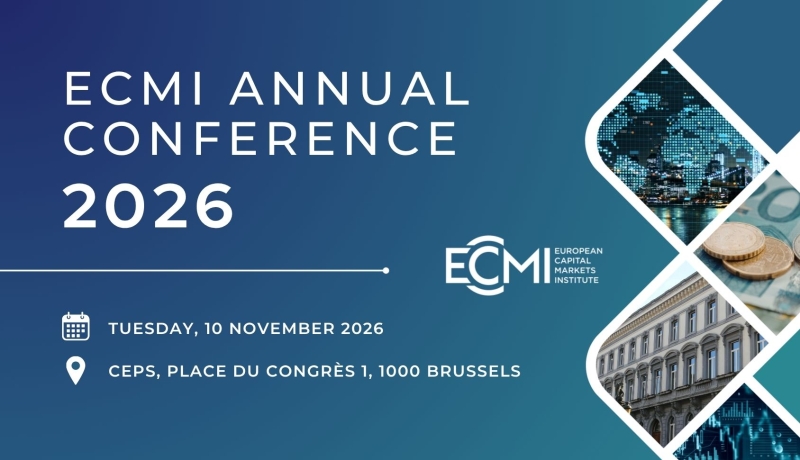
The 2026 ECMI Annual Conference will address the structural challenges that continue to shape the future of Europe’s capital markets. This year’s edition will focus on three interlinked priorities: advancing market integration and supervisory convergence through the Market Integration and Supervision Package, strengthening the capacity of EU capital markets to finance European scale-ups and future champions, and reinforcing the role of intermediaries, liquidity providers and market infrastructures in supporting deeper and more competitive markets. Through high-level panels and discussions, the conference will explore how Europe can move from ambition to implementation and build capital markets that are integrated, resilient and globally competitive.
AGENDA REGISTRATION CALL FOR SPONSORSHIP
9:30 – 10:00 Keynote speech
- Vasileios Madouros, Deputy Governor, Monetary and Financial Stability, Central Bank of Ireland
10:00 – 11:00 First session: MISP and the future of EU capital markets: integration, supervision and competitiveness
The European Commission’s Market Integration and Supervision Package (MISP) is the most ambitious attempt in recent years to reshape the governance and integration of EU capital markets. Covering a number of financial regulatory frameworks, the package seeks to reduce market fragmentation, facilitate cross-border activity and strengthen supervisory convergence.
At a time when the EU is seeking to mobilise private capital for competitiveness, innovation, defence, the energy transition and strategic autonomy, MISP goes beyond institutional design. It raises a broader question: can Europe create capital markets that are deep, scalable and globally attractive?
This session will explore the implications of MISP for market integration, supervision and competitiveness. Discussions will cover the balance between EU-level and national supervision, the single licence, cross-border activity, the role of ESMA, post-trade integration, market fragmentation, liquidity and growth financing.
Will MISP significantly deepen EU capital markets integration? How far should supervisory powers be centralised at EU level? Can Europe reduce fragmentation without adding further complexity? What are the implications for exchanges, trading venues, asset managers, banks and market infrastructures? How does MISP fit within the broader Savings and Investments Union agenda?
- MEP Eero Heinäluoma
- Florian Christiaens, Financial Services Attaché, Permanent Representation of Belgium to the EU and Belgian member, Council's Financial Services Committee (FSC)
- Jakub Michalik, Chief Policy Officer & Member of the Executive Committee, Euronext
- Pablo Portugal, Senior Public Affairs Director, Compliance and Public Affairs, Euroclear
11:00 – 11:30 Coffee break
11:30 – 12:00 Fireside chat
12:00 – 13:00 Second session: Scaling up Europe: can EU capital markets finance the next generation of European champions?
Europe has long been successful at creating innovative start-ups, but far less successful at helping them scale. Too often, European firms relocate abroad or rely on non-European capital once their financing needs reach later growth stages. As the EU seeks to strengthen competitiveness, technological sovereignty and strategic autonomy, the key question is whether Europe can finance, retain and grow its own companies.
The recent launch of the Scaleup Europe Fund marks an important step in closing Europe’s scale-up financing gap. But broader action is also needed to mobilise pension, insurance, institutional and retail capital, improve initial public offering (IPO) market attractiveness and build deeper European growth markets.
This session will examine how EU capital markets can support companies from late-stage venture financing to public markets, and what role private capital, public-private partnerships, market infrastructure and regulation should play.
Can the Scaleup Europe Fund become a transformative instrument? Why does Europe continue to struggle with late-stage financing and IPO retention? How can institutional and retail capital be better mobilised? Can Europe build globally competitive capital markets without losing its most promising companies abroad?
- Karine Cenci, Head of Cabinet of Chief Executive, European Investment Fund
- Henriette Peucker, Chief Executive and Member of the Board, Deutsches Aktieninstitut
- James Sawyer, Head of Public Affairs, EQT
- Jean-Charles Velge, Co-Founder, Qover
13:00 – 14:00 Lunch break
14:00 – 14:30 ECMI Best Paper
14:30 – 15:00 Fireside chat: Advancing gender equality in capital markets: from awareness to action
- Katie Kelly, Senior Director, and Lead of the ICMA Women’s Network, ICMA
15:00 – 16:00 Third session: Intermediaries, liquidity and competitiveness: strengthening Europe’s capital markets ecosystem
Deep and competitive capital markets depend not only on issuers and investors, but also on a diverse ecosystem of intermediaries. Exchanges, trading venues, market makers, asset managers, investment banks and post-trade infrastructures help allocate capital, provide liquidity, support price formation, manage risk and connect savers with investment opportunities.
As the EU seeks to strengthen the Savings and Investments Union and improve the competitiveness of its financial sector, increasing attention is being paid to whether regulation and supervision support these market functions. Capital requirements, reporting obligations, market structure rules and supervisory practices all influence the ability of intermediaries to provide liquidity, commit capital and support market development.
This session will explore how financial intermediaries can help build deeper, more liquid and more competitive European capital markets. It will focus on the interaction between regulation, supervision and market structure, setting the scene for a discussion on liquidity, resilience, competitiveness and the Savings and Investments Union.
What role do intermediaries play in supporting Europe’s capital markets ecosystem? Are current regulatory and prudential frameworks calibrated appropriately to support liquidity and market depth? How can Europe strengthen its capital markets without undermining financial stability? What lessons can be drawn from other jurisdictions? And what role should intermediaries play in advancing the Savings and Investments Union?
- Andrea Beltramello, Head of Unit, Savings and Investments Union Coordination, DG FISMA
- Laurence Daures, Professor of Finance, ESSEC Business School
- Guylaine Vandooren, Head of EU Government Relations & Policy Affairs, Optiver
- Vegard Vik, Special Advisor, Norges Bank Investment Management
16:00 Closing
Partner
Gold sponsors

Registration is free of charge for ECMI/ECRI/CEPS members, EU/national institutions, academia, and press. Other participants may be admitted for a fee of EUR 300.